The Central Sea Raft Voyage
A Journey to the Centre of the EarthThe Central Sea Raft Voyage is the expedition’s transition from travel on foot to a crossing of the underground sea. It turns fossil wood, rope, a linen sail, and Hans’s practical skill into the means of pushing toward unknown regions; the voyage also tests the travellers’ assumptions about the subterranean world and exposes the danger of distraction aboard the raft.
Building a Vessel from Fossil Wood
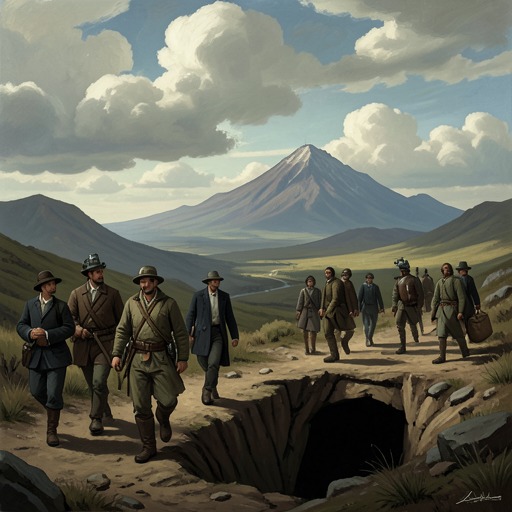
After walking for about a quarter of an hour beyond the natural port’s promontory, the narrator finds Hans at work beside a half-finished raft. Beams of a peculiar wood and a scatter of limbs, joints, boughs, and other pieces lie across the sandy shore—enough material, he thinks, for a fleet of boats. His astonishment turns to a question of buoyancy: if the wood has fossilized, might it not be as hard and heavy as iron, like lignite?
The Professor answers by distinguishing fully transformed wood from pieces that have undergone only one phase of fossilization. Rather than settle the question through explanation alone, he throws samples into the sea. They disappear momentarily, then rise and float with the motion of wind and tide. This small demonstration gives the raft its indispensable material basis and marks a change in the narrator’s expectations: repeated exposure to the interior of the Earth has begun to loosen the limits of what he regards as possible.
Hans’s industry completes what the raw materials make feasible. By the next evening he has finished a raft about ten feet long and five feet wide, its beams firmly bound with stout ropes. The improvised craft is launched by the travellers’ combined effort and floats tranquilly on the Central Sea. It is not an abstract promise of exploration but a solid platform, made from the shore’s fossil remains and secured by rope, on which the expedition can carry its supplies and equipment.
Embarkation and Navigation
On August 13 the party rises early to begin a new, faster and less fatiguing mode of travel. The raft’s rig is assembled from available materials: two pieces of wood form a strengthened mast, another piece serves as a yard, and a linen bed sheet becomes the sail. The whole arrangement appears solid and seaworthy when tested. At six in the morning, the Professor gives the signal to embark, and the travellers load their food, luggage, instruments, weapons, and a good supply of fresh water collected from springs in the rocks.
Hans has made a rudder with considerable ingenuity and takes the tiller. The narrator releases the painter holding the raft to shore; the sail catches the wind, and the vessel moves rapidly away from the little port. The launch opens a new leg of the expedition, once again aimed at distant, unknown regions. The practical division of work is clear: the Professor directs the undertaking, the narrator releases the raft, and Hans’s skill makes it steerable.
Observations and Food at Sea
The voyage begins under a steady northwest breeze. On August 14 the raft makes rapid progress in a straight course, while the coast remains dimly visible about thirty leagues to leeward and nothing can be seen beyond the horizon ahead. The light stays at an extraordinary but apparently unchanging intensity. The travellers record these conditions alongside a thermometer reading of plus 32 degrees centigrade, treating the unfamiliar sea as a place to observe as well as cross.
At about noon, Hans baits a hook with a small piece of meat and casts his line. The narrator has been wondering whether the subterranean waters contain fish; after a long wait, the line takes a sudden, hard tug. Hans draws in a struggling fish, which the narrator identifies as a small sturgeon. The catch answers the question by direct demonstration, just as the floating wood did: the sea is not lifeless, and its resources may matter to the travellers’ survival.
The first fish does not remain an isolated curiosity. After re-baiting the hook, the party catches a large number of Pterychtis and fish belonging to the supposedly extinct Dipterides family within two hours. Every specimen is blind, and the Pterychtis have no organs of sight. The Professor cannot classify the Dipterides exactly, but the catch renews the party’s provisions in a practical way. Their observations also suggest that the subterranean sea contains fish known to science as fossils, with fish and reptiles appearing more perfectly preserved the farther back their origins are placed. The travellers begin to hope that they may encounter saurians reconstructed from scattered bones or cartilage, though that hope is not itself a discovery made during this stretch of the voyage.
A Narrow Escape on the Raft
The crossing’s forward movement is interrupted when the Professor notices the narrator staring with his eyes wide open, apparently like a sleepwalker. The narrator cannot clearly see his uncle or make out his surroundings. The Professor warns him that he is about to fall into the sea; at the same moment, Hans seizes him from the other side with a firm hand.
The danger is immediate: without Hans’s presence of mind, the narrator would have fallen into the waves and drowned. The Professor shakes him and asks whether he has gone mad, but the rescue itself depends on the guide’s quick intervention. The episode sharply qualifies the apparent ease of the raft’s progress. Wind, sail, rudder, and provisions make the crossing possible, yet a moment of inattention can turn the floating platform into the edge of a fatal fall. Hans’s practical competence, already visible in constructing and steering the vessel, becomes decisive once more in keeping the party alive.